Founder

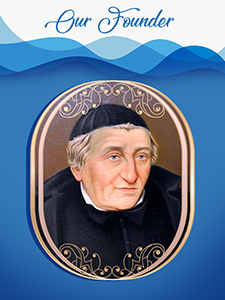
Our Founder, Rev. Fr. Mathias Wolff SJ

Birth and Family

Mathias was born at Diekirch in Luxemburg, Europe, on 9th March 1779 to Mathias Wolff and Anna Maria Zenner, who worked hard for their rather large family. He was brought up in a sturdy, simple, and deeply religious family. Young Mathias had a bright intellect and a pious heart. At an early age, he showed a desire to become a priest. His uncle Fr. Joseph was a mentor and guide for him to grow up as a faithful child of God. As it was said of Nazareth, so it was said of Diekirch: “Can any good come from Diekirch?” The Diekirch boy resolutely proved his understanding, goodness, and godliness, which was evident from his strong willpower, cheerful optimism, and great trust in God.

Mathias - becoming a Priest, and a Jesuit

The prevalent French Revolution between 1789-1799 affected young Mathias’ life and that of his country folk. However, it also offered a turning point in his life that pushed him forward to realize his long-cherished dream of becoming a priest, a Jesuit, and a man for others. The Jesuit order was suppressed in Europe from 1773 to 1814, and the Governing Party, mostly consisting of Protestants, could not tolerate the powerful influence of Jesuits in the education and faith formation of the Catholics.

Despite the French Revolution and suppression of the order of Jesuits, at last, the road to his priesthood was opened. On 9th April 1801, Wolff was ordained as a deacon and on 25th April 1802, he was ordained as a priest by the Mgr. De Marie, the bishop of Cologne, after Pope Pius VII had gladly dispensed him from the canonical age of 24, required for ordination. The young priest, now 23 years old, began his priestly ministry with great zeal in the parish of his reverend uncle, and later in various other places as curate, parish priest, teacher, and professor in the seminary. Without a doubt, Fr. Mathias experienced the divine power bestowed on him. His inner strength came from his humility and great trust in God’s grace, despite the delay in his studies due to the revolution and internal difficulties.

The year 1814 brought a turning point in his life. He wanted to be a Jesuit! The happy news of the restoration of the Society of Jesus all over the world reached Mathias. On February 13, 1815, Mathias entered the Novitiate of the Society of Jesus, thus becoming Fr. Mathias Wolff S.J. He knew well that he was surrendering himself with an ardent zeal for the extension of the Kingdom of Christ, and for ‘Ad Majorem Dei Gloriam – i.e., for the greater honour and glory of God.

Sent as a Missionary to Culemborg

After the revival of the Jesuit order in 1814, the newly appointed Superior understood the urgent need to send Jesuits to Culemborg, Holland. Fr. Mathias was sent as a missionary to Culemborg, his first mission as a Jesuit, on 7th June 1816. The presence of an energetic missionary was needed to handle the situation where Catholicism was fast losing ground, owing to the insufficient care of souls. Dutch Catholics suffered suppression, which added to their sense of inferiority, and lack of courage in the political and social sphere. They were shunned from public life and suffered from being pushed into the catacombs; thus, were called a clandestine Church. How was this timidity of the Dutch Catholics conquered from centuries of suppression? How did the courage grow in them to emerge from the catacombs to liberty?

It was Fr. Mathias Wolff, a man of God and a man of people, the miracle man of Culemborg and Nijmegen, the ravening wolf from the tribe of Benjamin, who brought forth the Spirit and Life in the Church of the Netherlands and led her to liberty.

The foundation of a great initiative

The impact of the French Revolution affected the Catholic faith to a great extent. It was the miserable plight of the girls and young women of Culemborg that moved Fr. Mathias to think of more relevant, far-reaching, and uplifting initiatives. Although freedom of religion was guaranteed, in the eyes of many, the Netherlands was a Protestant nation. The Catholic population was poor on the whole, and Catholic parents preferred to keep their children away from school and send them to work in the factories or in the fields. Their oppression, powerlessness, mute endurance of the atrocities, and neglect by the government disturbed him. The education of the poor girls was at stake; hence, they were, in every way, voiceless.

Something had to be done for the multitude of children, especially for the poor. Fr. Wolff was aware of the difficulties and the policy of the government that forbade the foundation of convents. Nevertheless, the young and passionate Fr. Mathias had a vision and a dream that he would take every risk and every possible means to realize his dream. Notwithstanding all this, he was seriously considering the possibility of founding a religious Congregation for the education of girls. However, everything had to be done in secret.

Birth of the Society of Jesus Mary Joseph

Moved by the Spirit, once Fr. Wolff was praying for light, and something incredible happened that he considered it as a sign from heaven. Three young girls revealed their desire to him to devote their lives to God in the religious state. They were Maria Stichters (Sr. Mathia Stichters), Sophie Miltner (Sr. Rosalie Miltner) and Lebuina van Elck (Sr. Lebuina van Elck). They were sent to Ghent in Belgium to the sisters of Notre Dame to be trained in Religious life, under the direction of Fr. Mathias Wolff, as a first step to realize his plan of starting a new Congregation for Women. He founded the Congregation on 29th July 1822, in Amersfoort, and named it, the Society of Jesus Mary Joseph, which was known as ‘Pedagogie Chretienne’ meaning Institute of Christian Education.

The first sisters took their temporary vows on 24th June 1824. From the inception of the Congregation, Fr. Mathias Wolff directed his sisters strongly on obedience and often exhorted them saying, “I want to work for God like a giant and I wish to win as many souls as I can”. He nourished them with unbounded confidence and childlike trust in the goodness and mercy of God. Quickly the congregation spread out to the whole of the Netherlands under the leadership of various Superiors General. Father Wolff was satisfied with the beginning. Ever cheerful and humorous, he visited the sisters and encouraged them to be faithful to their commitment to God.

Fr. Wolff in God’s Great Vineyard

Fr. Mathais Wolff was a man of great importance, both as a founder of a Congregation and a universally acknowledged minister of the Catholic revival in the Northern Netherlands. His mission as a priest, for the people in Culemborg and Nijmegan made his mark far and wide. While Father Wolff was preaching, people came rushing in large numbers, for all wanted to see the wonderful man, about whom they have heard so much. He was not only successful in his missions for the people but was also an eminent guide for priests. He was always keenly interested in the development of his congregation and gave the sisters spiritual instructions and retreats.

Heavenly abode of the Founder

From 28th October 1857, Fr. Mathias Wolff’s ill health affected his intellect, memory, and speech. Although his condition was so serious, he prayed continually. Three days later, at 10 am on October 31st, 1857, at the age of 78, Fr. Wolff bequeathed his spirit, just as he lived, full of trust in God’s mercy, as he always wished, on a Saturday, the day on which his heavenly Mother is especially honoured.

Fr. Wolff’s Mortal remains – Heeswijk

Mathias Wolff was buried first in the ground of the Jesuit cemetery at Culemborg market yard. His tomb was opened thrice in 1867, 1923, and finally in 1970; the mortal remains of Fr. Wolff were shifted from Mariakroon to the Cemetery of JMJ sisters at Heeswijk.

Fr. Wolff – A Man of God

Fr. Mathias Wolff was a man of God, a man of the people, and a powerful fighter for the honour of God. His departure left Culemborg in great sorrow. The “saint” had died, and everybody wanted to have a souvenir. The Church in the Netherlands acknowledges the extraordinary merits and services of Fr. Mathias Wolff, as the parish priest in Culemborg and Nijmegen and his heroic and selfless service as the faithful Priest of Christ in the nineteenth century for the Liberation of Catholicism out of its clandestine existence.